

ACADEMIC CITATION & REFERENCE VERIFICATION
Citation & Reference Checker: Cross-Check In-Text Citations Against Your Bibliography
Verify that in-text citations have corresponding references and that your bibliography contains no unused sources. Detect style inconsistencies with traceable document findings before submission.
EDITORIAL ACCURACY
Hidden Citation Flaws Undermine Manuscript Authority
Citation errors are among the most frequent structural issues found during peer review. Common flaws include:
Citations Missing from Bibliography
In-text references that lack a matching entry in the final reference list, causing verification failures for editors and reviewers.
Unreferenced Bibliography Entries
Sources listed in the bibliography that are never actually cited within the body of the manuscript.
Style Inconsistencies & Formatting Drift
Mixed citation formats (e.g., mixing author-date and numbered styles, or subtle deviations in punctuation and year placement).
WHAT PHILOLOGICA CHECKS
Rigorous Citation & Reference Cross-Validation
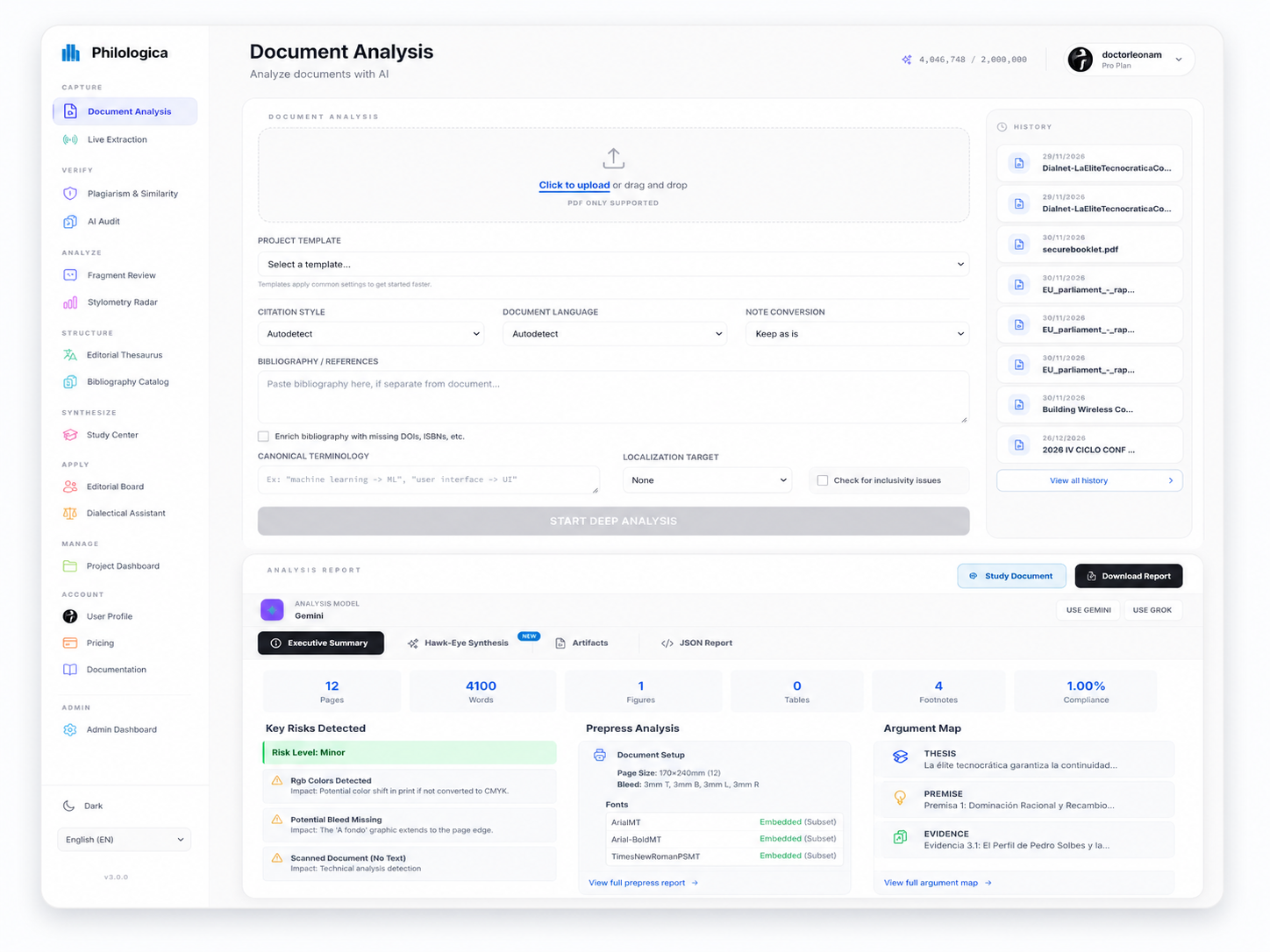
Philologica's Document Analysis performs deep structural extraction to reconcile citations and sources:
In-Text to Bibliography Reconciliation
Extracts citations across all manuscript chapters and systematically cross-references them against the bibliography table.
Orphan & Uncited Source Detection
Pinpoints sources in your bibliography that lack supporting in-text citations, ensuring a clean and verified reference list.
Citation Style Verification
Analyzes adherence to key academic citation conventions including APA, MLA, Chicago, Harvard, and custom guidelines.
Supported Academic Citation Styles
Philologica verifies structural patterns for widely used journal and publisher formats:
TRACEABLE FINDINGS
Section-Linked Evidence Rather Than Vague Advice
Each citation finding is directly linked to the specific chapter, page, and excerpt in your manuscript.
Citation Audit: 4 Discrepancies Detected
Unmatched in-text citation
Citation '(Vargas, 2021)' on page 14 has no corresponding entry in the bibliography table.
📍 Chapter 3 · Page 14 · Paragraph 2Unused bibliography entry
Reference 'Miller, K. (2019). Structural Linguistics' is listed in references but never cited in text.
📍 References · Page 36 · Entry #42Style formatting drift
Switch from author-date format '(Smith, 2020)' to footnote citation style in section 4.2.
📍 Chapter 4 · Page 22 · Paragraph 5Scope & Editorial Limitations
Philologica supports first-pass verification and consistency auditing. Note the following boundaries:
- Philologica cross-checks structural citations and bibliography entries. It does not replace subject-matter peer review.
- Verification depends on text extraction clarity from uploaded PDF, IDML, or INDD documents (up to 20MB).
- Human editorial judgment remains essential to confirm appropriate context and scholarly attribution.
HOW IT WORKS
From Manuscript Upload to Citation Report in 4 Steps
Upload your manuscript file
Upload your PDF, IDML, or INDD manuscript (up to 20MB) into the secure Document Analysis workspace.
Select citation style & review depth
Choose your target style (APA, MLA, Chicago, Harvard, or Auto-detect) and configure analysis preferences.
Automated cross-check processing
The engine extracts in-text markers, parses the bibliography table, and generates the citation crosswalk.
Review traceable report & export
Examine severity-ranked citation findings linked directly to manuscript locations and export your PDF report.
TRANSPARENT PRICING
Start With Free First-Pass Analysis
Starten Sie kostenlos mit vollem Zugang zu allen Philologica-Modulen im Starter-Plan (0 €/Monat). Upgraden Sie auf Plus (9,99 €/Monat) oder Pro (24,99 €/Monat) für 8×–40× Kapazität oder nutzen Sie unbegrenzt gültige Zusatz-Kapazitätspakete (4,99 €–49,99 €).
Analyze My ManuscriptFAQ
Frequently Asked Questions
How does Philologica detect citation and reference mismatches?
Philologica performs document extraction to isolate all in-text citation markers and cross-references them against the bibliography table, flagging any unmatched citations or unreferenced bibliography entries.
Which citation styles are supported?
Philologica supports major academic citation formats including APA, MLA, Chicago, and Harvard, as well as auto-detection and custom style rule prompts.
Which file formats can I upload?
You can upload PDF documents (verified via signature header), Adobe InDesign IDML, and INDD files up to 20 MB.
Is my uploaded manuscript kept private?
Yes. Submitted documents are processed securely and are never used by Philologica to train its own AI models. Processing and retention follow our strict Privacy Policy.
Does Philologica guarantee manuscript acceptance?
No. Philologica provides rigorous first-pass consistency and citation auditing to support your revisions. Academic evaluation and final acceptance remain with journal editors and peer reviewers.
Verify Your Citations and References Before Submission
Identify citation gaps, uncited bibliography entries, and style drift with traceable findings.
Analyze My Manuscript