

Citations without references
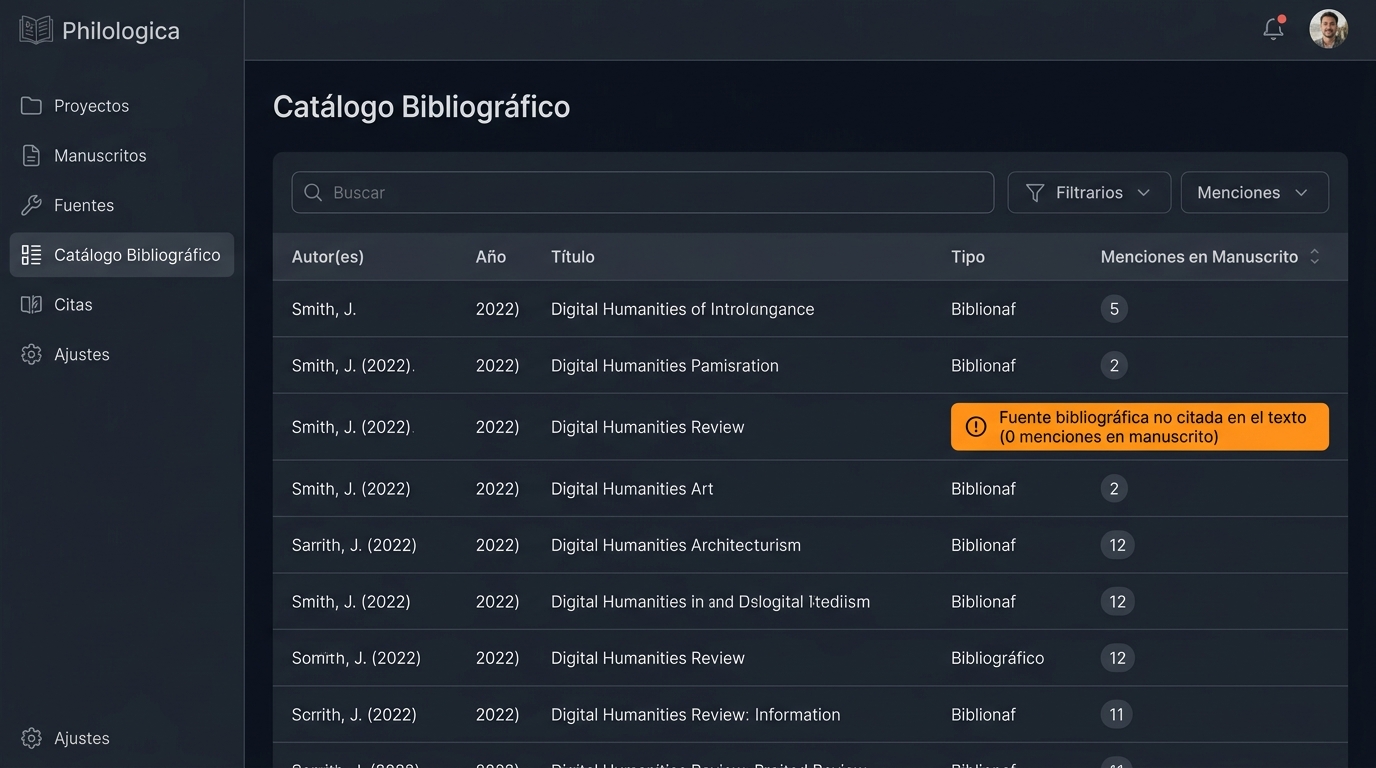
In-text citations that have no matching entry in the final bibliography list.
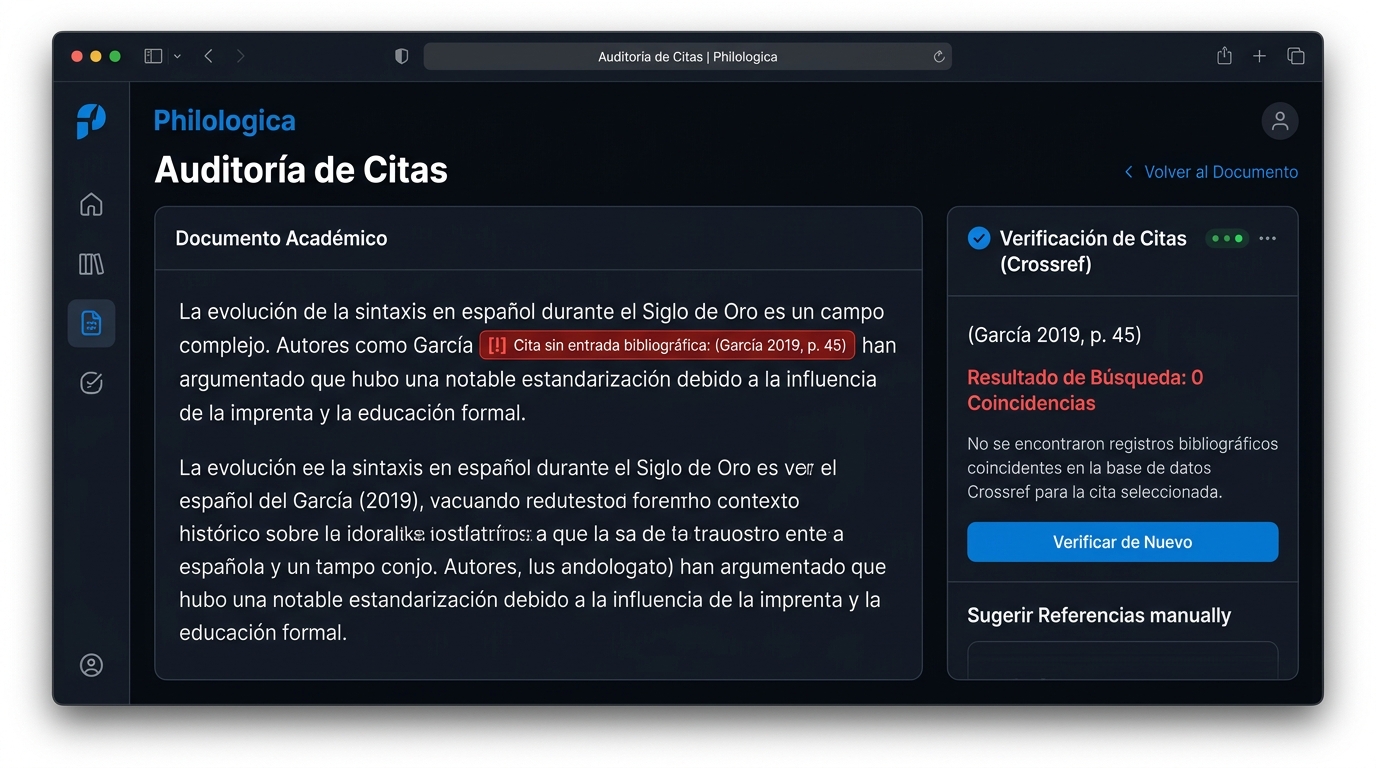
Result: Identify in-text citations missing bibliography entries and unused references.
EDITORIAL REVIEW WITH TRACEABLE AI
Traceable review of citations, arguments, and editorial readiness before submitting your manuscript.
Assisted review with full traceability. Final human validation is always required.



Third-party names and logos identify compatible services and do not imply endorsement.
DOCUMENT DIAGNOSIS
Before submitting or publishing, these six frequent issues compromise document quality and academic authority:
In-text citations that have no matching entry in the final bibliography list.
Sources listed in the bibliography that are never cited or referenced in the body text.
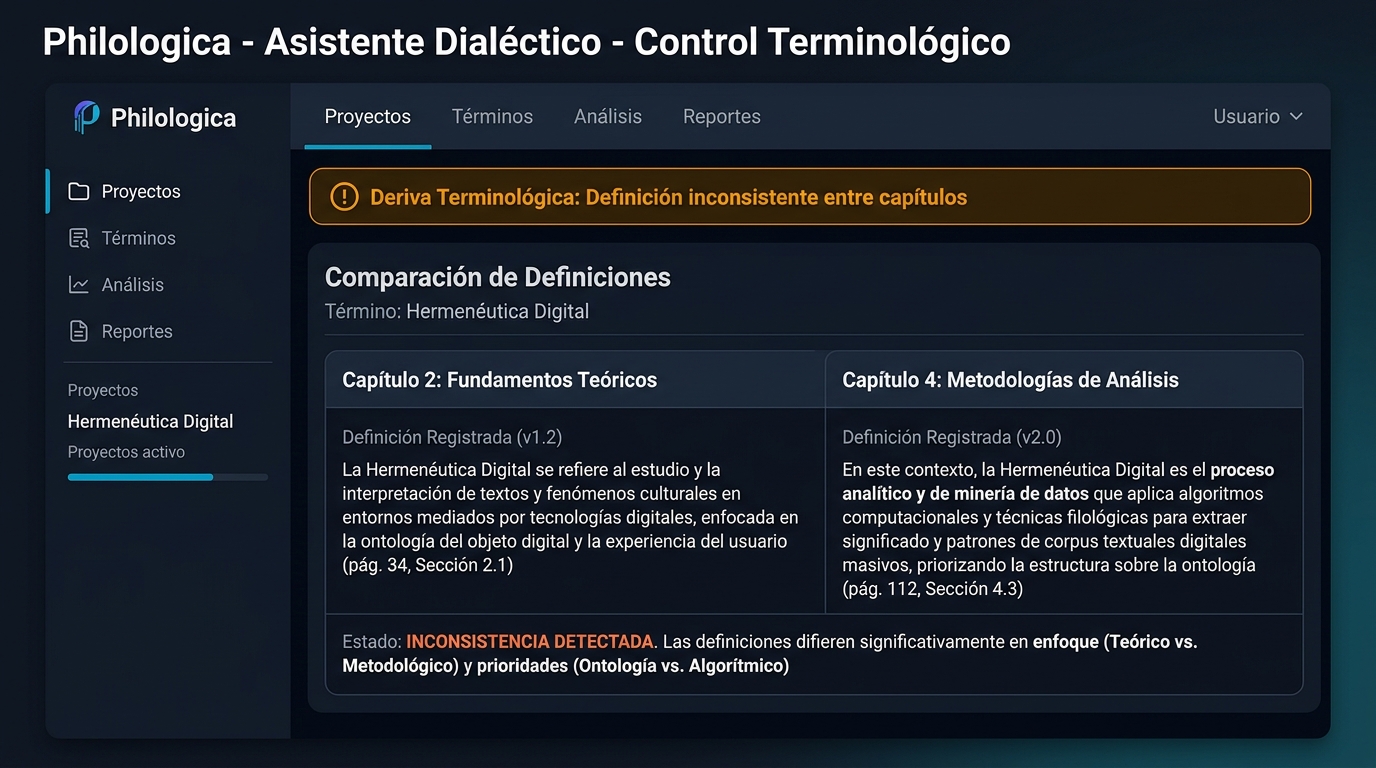
Core concepts or theoretical terms defined differently across different chapters.
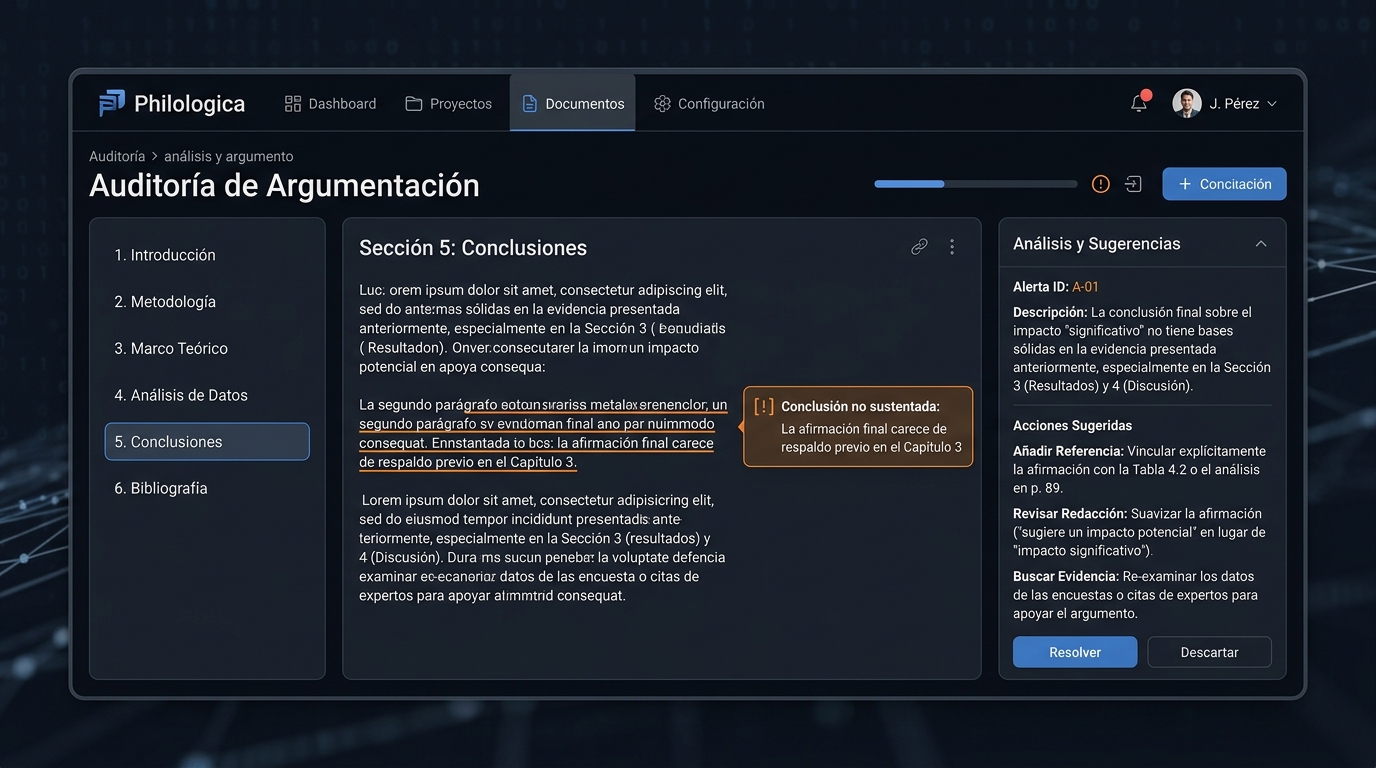
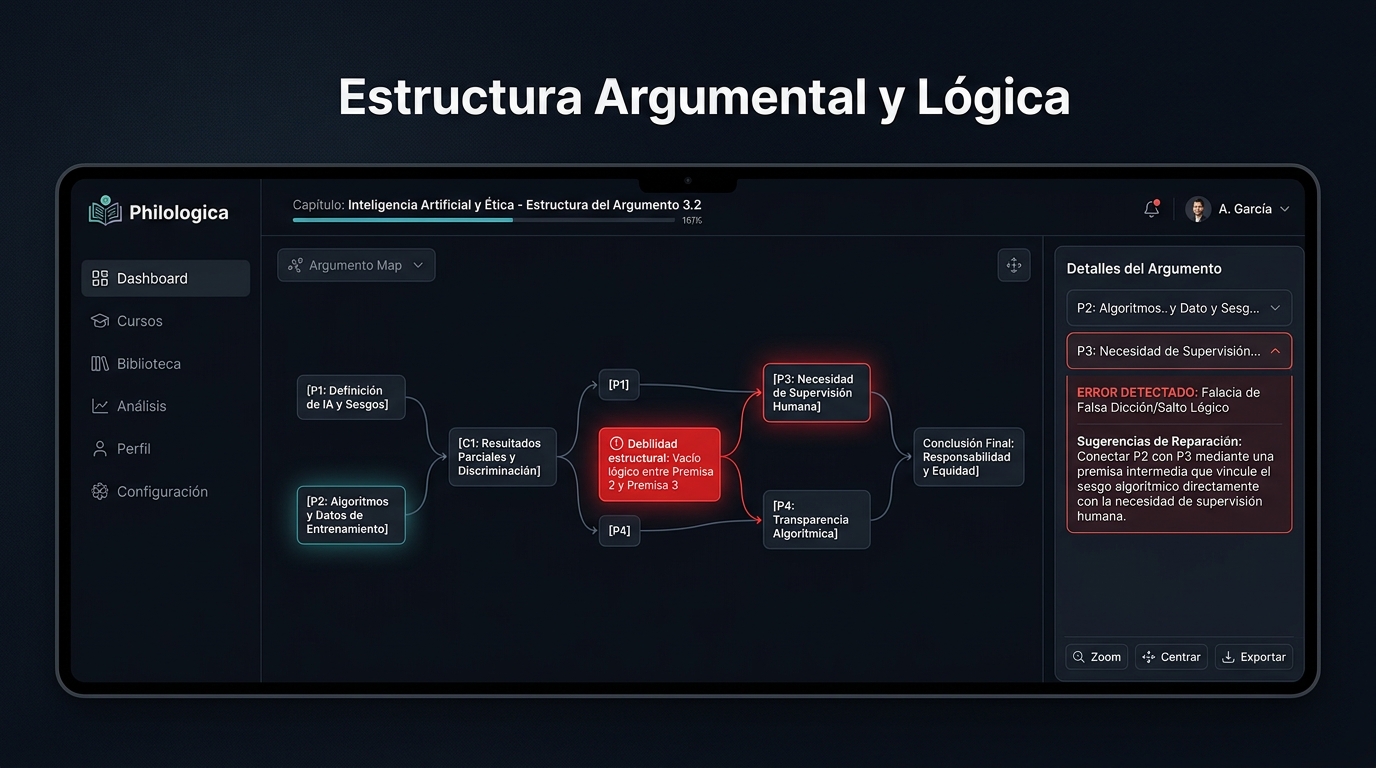
Final claims or propositions that do not follow from the presented arguments or data.
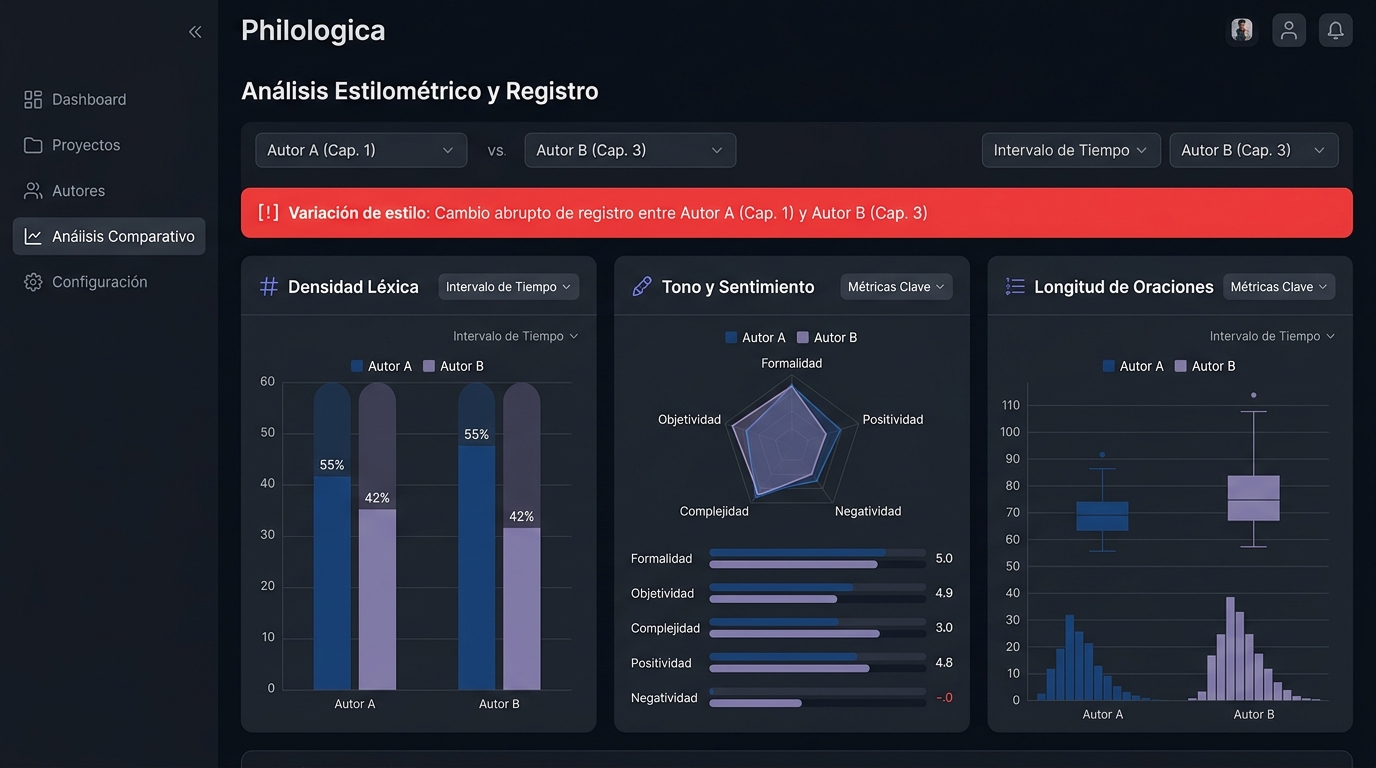
Sudden variations in tone, writing style or authorial voice between sections.
Repetitive arguments, incomplete premises or logical gaps in the manuscript structure.
TANGIBLE RESULT
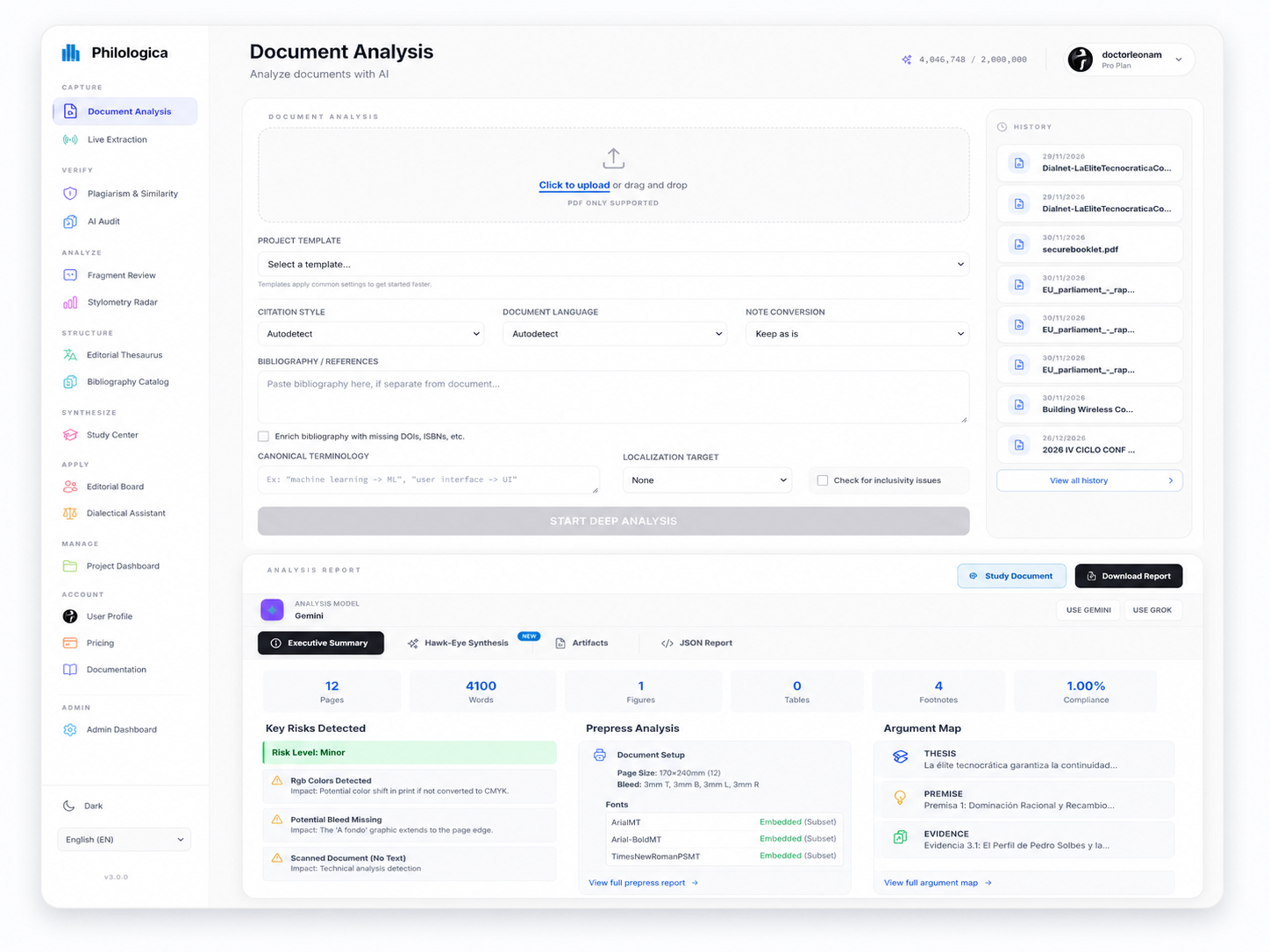
Philologica treats your document as a complete project, producing a clear, traceable assessment built for editorial decisions.
A concise overview of overall editorial readiness score and key review priorities before submission.
Issues clearly categorized into high-risk errors, medium concerns, and style improvement opportunities.
Direct linkage pointing to the exact chapter, page, and paragraph within your original uploaded file.
Clear explanation of each detected flaw, verifiable source references, and concrete text revision suggestions.
3 in-text citations do not have a matching bibliography entry.
The main term changes definition between chapters 2 and 4.
The conclusion introduces a claim not developed in the main argument.
WHY PHILOLOGICA
| Comparison area | General-purpose chat workflow | Philologica editorial workflow |
|---|---|---|
| Interaction model | User-defined ad-hoc chat prompt workflow | ✓ Predefined academic and editorial review tools |
| File handling | Variable window context or snippet limits | ✓ Whole document processed as a complete academic project |
| Output format | Continuous text requiring manual checks | ✓ Structured, prioritized and exportable report |
| Traceability | General text responses with unverified sources | ✓ Findings linked directly to manuscript sections and citations |
| Academic integration | General knowledge without live queries | ✓ Connected to Crossref, OpenAlex, DataCite, DOAJ & Open Library |
| Project continuity | Isolated chat sessions without version history | ✓ Project history, version comparison and editorial tracking |
Capabilities may vary depending on the general AI service and configuration.
TOOLS BY EDITORIAL GOAL
No need to browse a complex feature catalog. Choose your workflow goal and run the specialized tool:
Full manuscript evaluation
Complete diagnostic report detailing structural coherence, citation integrity, and readiness score.
Bibliographic audit
Cross-table linking in-text citations with external academic databases to verify publication data.
Conceptual and logical stability
Dialectic audit mapping core terms, definitions, premises, and logical transitions across chapters.
Register and stylometric check
Comparative metrics on lexical density, tone consistency, and voice uniformity between co-authors.
Pre-submission audit
Exportable PDF report ready for revision with virtual peer review simulation.
DEVELOPER PLATFORM · PRIVATE BETA
Connect MCP-compatible agents and AI applications to Philologica for traceable citation checks, academic evidence review, bibliography validation, manuscript preflight and structured findings.
Connect Cursor, Claude Desktop, Windsurf, or custom AGY agents in seconds using standard Model Context Protocol.
Direct HTTPS endpoints with Bearer authentication, request logs, key scoping, and OpenAPI schemas.
Every capability response returns explicit finding_id, evidence nodes, confidence metrics, and source URLs.
https://mcp.philologica.com/v1/agent/mcp
ℹ️ TEST access is available during Private Beta. LIVE access remains controlled under editorial verification.
citations.check_support3 PUCheck if source text supports a claimed academic proposition
citations.verify_reference2 PUValidate DOI, Crossref metadata, and bibliographic existence
manuscript.preflight20 PUExecute full structural, citation, and terminology audit
graph.trace_claim5 PUTrace supporting/refuting citation graph nodes
TAILORED USE CASES
Run a structured check before submitting your thesis or dissertation to ensure coherence and avoid critical mistakes.
Verify structure, citations and terminology before sending research papers to peer review journals.
Perform systematic initial evaluation and stylometric analysis on long manuscripts or edit collections.
Standardize first-pass checks across research teams without delegating academic judgment to AI.
TESTIMONIALS & REVIEWS
Real experiences in manuscript evaluation, citation auditing, and doctoral dissertation defense.

"Philologica has transformed pre-editorial review in our department. Auditing citations against Crossref and verifying argument consistency in minutes saves weeks of technical labor."

"Before submitting my dissertation, I ran the manuscript through the fragment review module. It caught two mismatched references and three conceptual inconsistencies before defense."

"For initial desk-review screenings, the structured report gives us an objective diagnosis of documentary rigor before sending papers out for peer review."

"The bibliographic audit and dialectic assistant are unbeatable. It doesn't just match text; it checks if the claim is genuinely backed by the cited source passage."

"Stylometric analysis helped us unify voice and lexical density in a co-authored book monograph. The improvement in coherence was immediately evident."

"We require postgraduates to run Philologica prior to final thesis deposit. The baseline quality of submitted manuscripts has improved dramatically."

"What sets Philologica apart is traceability: it doesn't invent filler content, but links every risk assessment directly to exact manuscript locations."

"Cross-checking local references against OpenAlex and DataCite saves hours of manual DOI lookup and eliminates bibliography formatting errors."

"I recommend Philologica to all my PhD students. It gives them confidence before submission and lets me focus on research contribution rather than proofreading."
HOW IT WORKS
Securely import your PDF or manuscript file into the workspace.
Select from structural analysis, citation audit, terminology or style evaluation.
Obtain an organized report ranking critical issues with exact document locations.
Human review remains essential. Revise your text and export the final report.
TRANSPARENCY & PRIVACY
Philologica combines structured processing with academic data sources. Your document is processed securely.
PLANS & PROCESSING CAPACITY
Subscriptions provide recurring tool access. Token packs add processing capacity for longer documents or deeper analyses. Taxes included.
€0/month
Explore the core workflow
€9.99/month
For students and authors
€24.99/month
For intensive editorial work
Estimated processing capacity. Actual consumption varies by document length, extraction quality, selected model, tool and depth.
Tokens represent processing volume. The application displays your remaining balance before executing any analysis.
100k · €4.99
Approx. 100 pages / 1-2 research papers (100k tokens)
View in app →500k · €19.99
Approx. 1 full PhD thesis (500 pages) or multiple papers (500k tokens)
View in app →2.5M · €49.99
Approx. intensive research or multi-manuscript projects (2.5M tokens)
View in app →FOR ACADEMIC INSTITUTIONS
Designed for university departments, research groups and publishing teams. We can define a limited pilot around a real manuscript workflow before discussing an institutional rollout.
Clear answers about scope, privacy, AI output and token capacity.
Depending on the selected tool, it examines structure, terminology, argument validity, citations, bibliography, style and editorial risks.
Philologica is not a general chatbot. It processes entire documents as projects, provides section-by-section traceable reports, integrates live academic databases (Crossref, OpenAlex), and offers specialized editorial tools.
Submitted documents are not used by Philologica to train its own models. Processing and retention depend on the selected service and are described in our Privacy Policy.
Estimated processing capacity. Actual token consumption varies by file size, extraction quality, selected model, tool and review depth.
No. Philologica is designed to support first-pass analysis and revision. Findings require human verification and ultimate academic judgment remains with authors and editors.
Yes. We offer pilot programs for university departments and research groups with dedicated privacy and workflow agreements.
Explore the application for free, or contact us to discuss an editorial or institutional workflow.